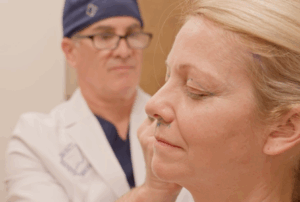
Facial Implants
There are multiple ways to achieve more balanced facial definition. Most often, board-certified plastic surgeon Dr. Scott Miller is able to achieve a natural, youthful appearance by utilizing one’s own facial tissue through lifting and supporting facial muscles, as well as structural fat grafting. In some cases, a facial implant can be of use.
Facial implants can provide long-lasting enhancement to different areas of the face, such as the chin, cheeks, jaw, or temples. By augmenting these areas, you can add definition to a weak chin or jawline, restore volume to aging temples, or increase fullness in sunken-looking cheeks.
“I am so happy with his work. And nobody would know I’ve had any work done unless I told them. I indeed look completely natural.”
- Overview:
- Facial implants are a highly customizable solution used to enhance and define the natural contours of the face. Most commonly placed in the chin, cheeks, or jawline, these biocompatible implants are carefully selected to complement each patient’s anatomy and accentuate more defined facial angles.
- Treatable Concerns:
- A facial implant is ideal for correcting naturally weak or underdeveloped facial features, such as a recessed chin, flat cheekbones, or a lack of jawline definition. Chin or cheek augmentation can also restore proportion in patients who feel their features are out of balance, enhancing symmetry and creating a more refined profile.
- Candidates:
- Good candidates for facial implants are in good overall health and seeking long-term enhancement rather than temporary improvement. Patients should desire more definition or structure in specific areas of the face and have realistic expectations about their results.
- Procedure:
- Facial implant surgery is typically performed on an outpatient basis under general anesthesia, usually taking 1 to 2 hours to complete. Incisions are placed discreetly, either inside the mouth or underneath the chin.
- Recovery:
- Recovery from facial implant surgery is encompassed by mild to moderate swelling and bruising in the early healing stages. Most patients can return to light activities within about one week, while more strenuous exercise should be avoided for several weeks.
Explore Topics On This Page
The Facial Implants Procedure
Once a personalized treatment plan has been developed, Dr. Miller will educate you on what you can expect throughout your facial implant procedure. Incision placement will ultimately depend upon the area that needs augmentation. Facial implants for the cheeks, chin, or jaw can typically be inserted through an incision in the mouth, making it easy to conceal potential scarring. For those who want to enhance the look of hollow temples, the incision can be equally as inconspicuous and may be placed within the hairline or along discreet contours of the ears. Rest assured that Dr. Miller will position the implant to ensure it creates the desired contour, while maintaining a very natural-looking profile.
Recovery from Facial Implants
Improvement in your facial contour should be apparent immediately following your surgery. However, due to bruising and swelling, it may take months to see your final results. Any discomfort felt during your recovery can typically be well-controlled with medication. More specific details of your recovery and results will be discussed with you prior to your surgery. If you have any questions or concerns, please do not hesitate to reach out to our office.
To learn more about facial implants, please contact us to schedule your consultation with Dr. Miller.